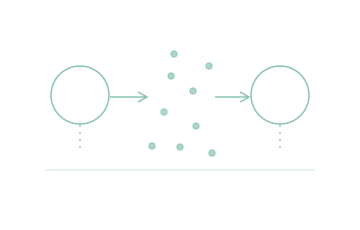
Intelligence may live in an agent. It may also emerge through
relationships. Flockinator brings those interactions into light and
sound, so we can notice what is worth understanding.
A visual and auditory microscope for collective behaviour.
01 / WHY MAKE IT PHYSICAL?
Give curiosity something to notice.
A sudden synchrony. A call answered across the wall. One node that
hesitates while its neighbours commit. A pattern that disappears
when communication is interrupted.
We are pattern-seeking animals. Motion, spacing, contrast and rhythm
give us ways to recognise relationships that are hard to follow
across separate streams of logs. The wall is designed to put those
senses to work: each node has a visible place and can have an
audible presence.
That is why Flockinator exists. It turns an agentic system into
something we can watch and listen to while AI explores strategies
for individual objectives and for the flock as a whole. A surprising
pattern becomes a question we can investigate.
Human perception is also fallible. A display can make unrelated
events seem connected. The microscope helps us discover questions;
recordings, comparisons and repeatable tests help us answer them.
Change the boundary you draw around the system, and a different kind
of behaviour becomes visible.
THE INDIVIDUAL
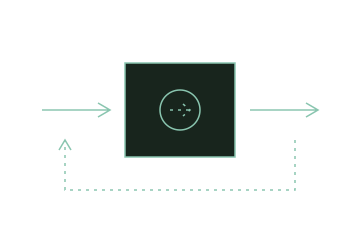
An agent acts.
An agent receives observations, uses a rule or policy to choose an
action, and affects its environment. It may have memory and an
objective. Its policy might be simple code, a learned model or a
larger AI system.
What can this node know and do on its own?
INTER-INTELLIGENCE
Relationships matter.
One agent’s action changes what another observes or does.
Messages, imitation, disagreement and trust can make coordination
possible. They can also spread error. The connections are part of
what we study.
What changes when these nodes interact?
EXTRA-INTELLIGENCE
The system has a scale.
Here, “extra-intelligence” is a working name for useful
capabilities that extend beyond an individual agent: distributed
across a group, its connections, shared environment and feedback
over time.
What can the whole system achieve that one node cannot?
“Inter” and “extra” are lenses for this project, not a settled
scientific taxonomy. Research often discusses these questions as
collective intelligence, distributed cognition and emergence. The
boundaries and mechanisms are still active subjects of inquiry.
Couzin’s review of collective cognition ↗
A pattern can emerge without learning.
Simple local rules can produce coordinated motion without any
individual planning the whole shape. Reynolds’ boids model
demonstrates this through separation, alignment and cohesion. A
recognisable flock does not, by itself, tell us that learning has
occurred.
The original model ↗
A useful strategy needs an objective.
Optimisation asks what improves: coverage, accuracy, energy use,
resilience, or something else. Helping one node may hurt the
group. Flockinator lets us look for the trade-offs and test
whether an apparent collective advantage survives a different task
or condition.
03 / THE PARTS OF THE MICROSCOPE
One world. Many points of view.
The controller holds the consolidated experiment view. The
individual panels make the agents’ behaviour available to our
senses.
CONTROLLER
The world & the run
Shared state, timing, objectives and a view of the whole
experiment.
→
INDIVIDUAL NODES
Behaviour in place
Local states, decisions and exchanges, expressed through light
and sound.
→
HUMAN OBSERVER
Notice & question
Look for a motif, hear a rhythm, identify a surprise and mark
the moment.
↶
Observation → a testable question → comparison → a revised
strategy → another run
Conceptual information flow, not a wiring diagram. A consolidated
world view does not require every agent to receive all of that
information.
The Korvo controllerExperiment context
Holds the simulation clock and world state, hosts the planner
and learning lab, and provides the consolidated overview. The
experiment defines what each simulated agent is allowed to
observe. The controller’s complete view and a node’s limited
view serve different purposes.
Gives each node its own processor, identity and visible
position. The panel turns state and transitions into a legible
signal; its ESP32 drives the display and interfaces with local
peripherals. A physical node and an AI agent are related roles,
not interchangeable terms: a simulated policy may run on the
controller or host rather than on the panel.
The speaker gives a node a voice; the microphones let it listen.
This supports the intended auditory microscope and experiments
with acoustic interaction. The selected firmware and sound
mapping must be checked: audio output, audio sensing and a
working node-to-node acoustic protocol are separate
capabilities.
Sensors + communicationLocal context and relationships
Onboard sensors, optional proximity or light sensors, and
communication links can give nodes different observations and
ways to influence one another. Panel borders currently provide
communication cues. An optional ARGB/WLED grid can extend that
visual language into the spaces between nodes.
Node cards and controller archives preserve the records produced
by the chosen experiment. They let an interesting moment be
revisited alongside its configuration and decisions. A
successful file receipt establishes storage, not learning or an
intelligent outcome.
Reliable power and a serviceable mounting system keep the
experiment readable and repeatable. The gaps between panels
preserve each node’s identity. Brightness changes, resets or
failed connections can otherwise resemble changes in behaviour.
Implementation reference:
the Korvo standalone controller documentation. The public benchmark results come from host simulations. The
controller’s learning lab and physical-node acceptance are separate
parts of the project.
04 / WHERE AI FITS
Watch a strategy take shape.
The research ambition is to watch AI develop and refine strategies
for a flock and its individual nodes, while making the resulting
behaviour perceptible. An optimiser could change a policy,
communication rule, allocation of work or response to uncertainty.
The experiment supplies objectives and constraints against which to
compare those choices.
Keep three roles visible: the agents acting inside
the experiment,
the optimiser or model-assisted development process
proposing changes, and the observer noticing
patterns and deciding what to test next. They need not run on the
same hardware or at the same timescale.
AN ILLUSTRATIVE DISCOVERY
A rhythm appears across the wall.
Notice: a few nodes seem to alternate between
exploring and sharing, while others wait.
Ask: is a division of labour forming, or are
all nodes responding to the same clock?
Test: hold the task fixed, alter the
communication or timing condition, and compare coverage and cost
across repeated runs.
Learn: retain the explanation the evidence
supports, then try a revised strategy.
A proposed observation exercise, not a reported Flockinator
result. Sound is a designed cue only when the experiment’s audio
mapping is implemented and recorded.
The microscope is successful when it helps us find a better
question—even when the next experiment shows that our first
explanation was wrong.
Flocks and schools make coordination easy to see. Related questions
arise in living tissues, adaptive networks and information left in a
shared environment. The mechanisms—and the appropriate meaning of
“intelligence”—differ.
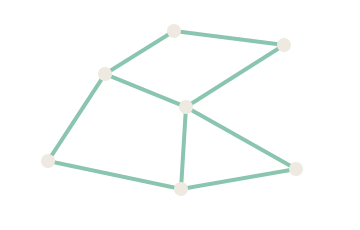
ANIMAL GROUPS
Coordination without a complete view
In flocks, schools and insect groups, interactions can turn
local information into group-level responses. A useful question
is how information travels, and when a minority can guide—or
mislead—the group.
Physarum slime mould can form adaptive transport networks. Tero
and colleagues compared their efficiency, resilience and cost
with infrastructure networks. A network can also be
one large cell with many nuclei, complicating the boundary between an individual and a
collective.
Development and regeneration require cells to coordinate at
tissue scale. Frameworks such as Levin’s TAME explore whether
concepts of agency and problem-solving help explain this
organisation. That is a research perspective, with definitions
and mechanisms to investigate.
Erez and colleagues found chemical communication in certain
bacteria-infecting viruses that influences later infection
outcomes. This is a striking example of information extending
beyond one individual event; it does not establish conscious
intent or a general intelligence in viruses.
Original conceptual illustrations. These examples motivate questions;
they do not establish that Flockinator reproduces the biological
mechanisms. Human teams and their tools offer another setting in which
to ask where an individual’s contribution ends and a system’s
capability begins.
06 / THE INVITATION
A microscope. An artwork. A mirror.
Flockinator is one experiment in translating agentic behaviour into
light, sound and motion that human senses can explore. It is a
discovery tool and an artwork: a microscope for relationships we
might otherwise miss, and a mirror for our own assumptions about
intelligence, intention and cooperation.
The instrument shapes what we can notice. The signals we choose to
display, the objectives we set and the patterns we expect all
influence our interpretation. An unexpected rhythm may reveal
something about the agents—or about the way we are looking.
New scenarios, recordings and experimental overviews will keep this
an active investigation. Contribute code, critique an experimental
method, or propose another way to make emergent behaviour
perceptible and test what it means.
 THE INDIVIDUAL